Taking science AND faith seriously.
Episodes
Monday Jun 11, 2018
Monday Jun 11, 2018
We start off unpacking the climate change example further and provide some additional context from political science and seismology. The point is to use climate change as an object lesson in how to break down a big issue at least a little bit, which is what a good intellectual citizen needs to do.
That still leaves us with a picture of intellectual citizenship as a really, frighteningly large responsibility for all of us to try to bear. We spend some time discussing the other side of the issue: we either live in a universe with no loving Creator or moral principle of compassion, in which case it hardly matters what we do or don't do, or else we live in a universe that does have such a Principle, in which case our best effort is good enough, because that Principle has things well in hand no matter what we do. If we let that sense of security sink in, that frees us to start with whatever issue attracts our attention first and go from there. We can take almost any example and infer some principles from that, which can be taken to other problems in the world.
Another point inspired, at least indirectly, by The Death of Expertise is the thought that all of us...certainly all of us who have an interest in the subject matter of this podcast...can, should, and probably already have become experts in something, so that we have offer something back to the world. That very expertise also gives us a lot of grist for considering the work of other experts and coming to some sort of judgment as to whether they are fulfilling their obligations and are more or less trustworthy.
Paul then asks Bill, in his personal expertise in journalism, for some pointers on how to judge media. Bill promises to discuss it more in the future, but takes some time to lament the decline many of us perceive in journalists' willingness to report as opposed to opine and engage in punditry.
Bill asks Paul to close out the podcast with a meditation on how model-based thinking could apply to religion as well as science. One prominent way is to consider how we use the examples of the lives of figures in Scripture and the saints to infer models of how human life can go. We don't get very far if we try to replicate another person's life exactly, and yet there are principles we can abstract from the examples of the saints that can help us on our way.
Apparently, we have not even touched on the issue that inspired Bill's original question about "intellectual citizenship." Whether we do that next episode remains to be seen.

Monday Jun 04, 2018
Monday Jun 04, 2018
Bill and Paul dive into a very simple question posed by Bill over email: "Please describe more what is intellectual citizenship?" That of course opens up a question that lurks behind every issue we discuss, and any philosophical or religious question touches upon, which is what we owe the universe, its Creator if it has one, and each other. We can't learn everything about everything, and we must make choices what to spend our time on.
In the political system we inhabit, in the U.S. and other contemporary representative democracies, we choose whom to trust to make decisions for us. There is a tendency to think about our choices in voting as a process of simply matching up policy preferences, but that leaves out of consideration the very important human question of which candidate will actually act on his or her stated policy preferences and do so effectively.
In our awareness of the broader world, when we give our allegiance to science, it's good to have an idea to what sort of thing we are pledging ourselves. Different sciences are at different stages of development and are more or less ripe for further paradigm shifts. Those paradigm shifts may come more or less "off in the distance," where they may or may not affect how we solve practical problems. The paradigm shifts we've discussed in physics didn't change how civil engineers made their calculations, but the plate tectonics revolution in the 1960s did have practical ramifications for economic geology and hazards assessment, just to name two things. The human sciences of economics, sociology, and psychology are good examples of sciences that are ripe for paradigm shifts. Indeed, currently, they are in the really unstable situation of having multiple competing paradigms.
When we apply science to a practical question, like the issue of climate change, being a good intellectual citizen means gaining at least some awareness of the different parts of the problem and the degree to which our experts can express certainty on each issue. Climate change requires at least three big components. First, we need the basic thermodynamics of how air and water respond to heat, how they move and mix. On that abstract level of physical laws, we have great certainty. Second, we need detailed data on the temperatures, wind speeds, air composition, etc. all across the planet. On that level, we have a great deal of data, but not as much as we could conceivably want. Third, we need models that run on as dense as possible a cluster of node points, which is to say models that divide up the atmosphere, land, and oceans into the largest number of little boxes possible; and likewise, models that take into account as much of the physics as possible, and not just a few of the elements. This is the really hard part, even with the computing resources we now have.
Bill wraps up the episode by noting how daunting we have made the question of intellectual citizenship and also how important the question of models is whenever we try to apply science...and maybe any body of intellectual knowledge...to our problems. We will take these questions as our point of departure for the next episode.
Monday May 28, 2018
Monday May 28, 2018
Bill’s introductory question: Would there be a quick curriculum in basic philosophical principles, including the philosophy of science, that could discourage people from assuming that science and religion are at incompatibly opposite ends of the spectrum of “how to think about things”?
We discuss the difficulty of canning a “curriculum” or “program” to address anything, let alone a problem as nuanced as this is, before plunging ahead and taking our chances.
Paul argues that there are actually significant parallels between the religious, and specifically Christian, concepts of “mystery” and “dogma” and inescapable aspects of thinking about and doing science.
A mystery is an issue within a system of religious doctrines where it is confidently pronounced that human debate and philosophizing will never exhaust the issue and solve it completely. That is very different than saying a mystery is something to encounter and then stop thinking. It’s the opposite. It’s a promise that continued thinking and contemplation will continue, world without end.
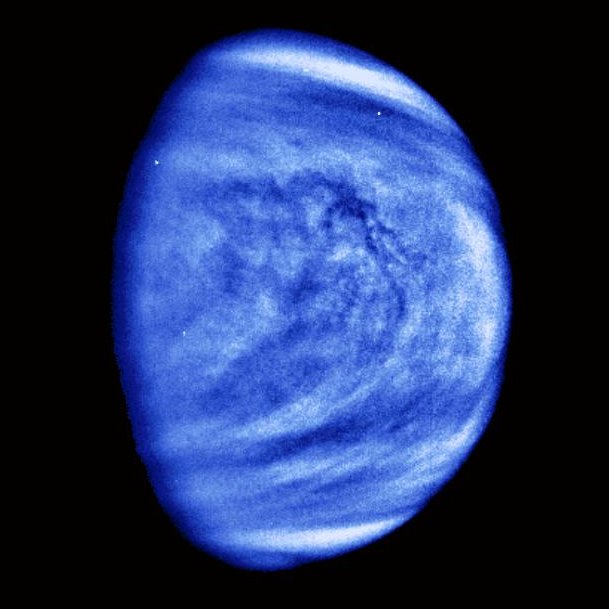
Even the concept of dogma has analogues, especially if you broaden your horizon of scientific thinking enough to take in the observational or descriptive sciences like geology, zoology, and paleontology. In these sciences, we try to understand phenomena that we don’t have the power to replicate. We can’t run the experiment “Venus” over again, changing the parameters until we understand for certain why it came out with this thick carbon dioxide atmosphere and high surface temperature as opposed to being more like Earth or Mars or anything else. We can do experiments that help us interpret the observations we make, but we have to accept the testimony of the geologic, paleontologic, or astronomic record as it has been presented to us.
Christian dogmas boil down to testimony. We can’t run the experiments Mary or Jesus of Nazareth over again. A Catholic Christian accepts testimony that has been handed down, and if he is a thinker of any kind, he works that into his worldview.
Again, key points in this discussion we owe to Stephen Barr’s Modern Physics and Ancient Faith.
Paul’s profile on Goodreads: https://www.goodreads.com/user/show/4658045-paul.
Monday May 21, 2018
Monday May 21, 2018
Resuming the cliffhanger: the breakdown of classical physics
Shift from the classical to the quantum paradigm
Light is in individual packets of energy whose size is keyed to the frequency of the light.
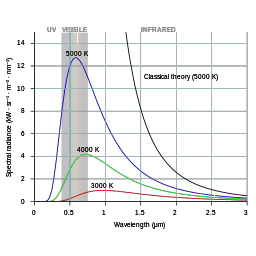
This is the solution to the blackbody problem: the mathematics of emission of quanta of light energy produces the well-behaved curve with a peak at a given color that we see for hot objects, whether the Sun, iron in a forge, or a light bulb filament
It is also the solution to the photoelectric effect: light of high enough frequency is needed for the individual light quanta to add enough energy to eject electrons. Apparently the atoms can only interact with these photon quanta one at a time; you cannot add multiple red photons to eject an electron, but rather you need a single blue one.
The spectra of the Sun (with absorption lines) and energized gases (like neon or sodium lamps, with emission lines) turned out to be compatible with this quantum theory as well. The structure of the atom itself must be quantized, and electrons must live in well-defined energy shells; when they move from one to another, they emit or absorb photons of a well-defined frequency. Quantum theory began to solve problems chemists did not necessarily even realize they had about, e.g., why chemical bonds tend toward exchanging or sharing electrons so as to reach the number 8 in the outer shell.
Still, even with all this evidence, as the saying went, “Science progresses funeral by funeral.” Many older scientists stayed in the old paradigm to the end of their careers, whether as recalcitrants who refused to even believe in the new paradigm, or perhaps more often as castaways adrift in the new sea, clinging to the old research programs they were comfortable with and hoping, implicitly, that their work would add up to something that would remain untouched in the new world order their students would inhabit.
Religion: why do people believe? Is it reasonable or just arbitrary?
Picture a craftsman in Corinth c. 50 AD/CE.
This guy named Paul shows up in the stall next to you and starts making tents. While he’s not making tents, he’s talking about this Jesus guy with these crazy claims that he’s been killed and then “rose from the dead,” whatever that means.
You don’t think too much of it until the day you watch him grab Alexander the cripple by the hand and he suddenly starts walking! You’ve seen this guy for 15 years sitting there begging…
Yet for all the miracles, do you change your beliefs?
It helps that Paul is talking about this Jesus as the Son of, not some Greek god few of you really believe in any more, but some transcendent God that sounds a lot more like Plato’s Form of the Good or Aristotle’s Prime Mover.
It helps a lot more that you see changes in yourself as you listen to Paul: the things you’ve done and the things you’ve suffered make more sense. You want the forgiveness and the joy that Paul says this Jesus brings.
All of which is to say, in both scientific paradigm shifts and religious conversions, it takes a convergence of falsified old predictions, verified new predictions, and the ability to fit things that still work from the old paradigm into the new paradigm for the paradigm shift to take place.
Thursday May 17, 2018
Thursday May 17, 2018
Bill prods Paul into discussing how the mindset of the saying, "Science progresses, funeral by funeral" and its attitude of constantly discarding the past in favor of the new has taken over the academy. It isn't the right mindset for, say, literature, or even for undergraduate teaching, but because of the prestige (and funding) accorded to science research in the modern university, other disciplines have begun to imitate it. Top researchers often do not make the best teachers, either...
Monday May 14, 2018
Monday May 14, 2018
Science’s origins in “natural philosophy”
Tension between Aristo-Thomist metaphysics, post-Cartesian idealism and Kantian/Humian criticism and etc., and science
Philosophy of science: what is it?
My own introduction: Popper and falsification key, Kuhn and the sociology of science revolutions / paradigm shifts
Tendency to exaggerate contrasts and play down common elements between them
Quantum foundations, classic experiments leading to quantum physics, wave-particle, uncertainty principle – falsifying classical physics, bringing about a new paradigm
Existing paradigms of classical physics & chemistry:
Light is definitely a wave phenomenon, period. It displays diffraction / interference effects that only make sense for waves, not little shooting corpuscules a la Newton
The electrons (protons and neutrons not being discovered yet) are particles with a given mass, location, charge, velocity.
Classical failures of light
Why do hot objects give off light, or rather, how? Classical physics applied to this problem winds up with a completely unworkable “ultraviolet catastrophe” where all objects at all temperatures have a frequency – intensity curve that shoots off to infinity.
Why do photoelectric materials only shed electrons once light of high enough frequency hits it? That makes no sense; it should be the brightness / intensity of the light that matters, right?
Monday May 07, 2018
Monday May 07, 2018
We follow up on last episode's promise to talk a little more about evolution. Evolution literally comes from the Latin "to turn outward" and had a huge meaning cloud. One classic image it might evoke is that of a flower bud opening and the petals turning outward to reveal the whole flower.
This is not an alien concept to religion, and certainly not to Christianity. The moment you take the Christian scriptures as a set of texts written by real people scattered across over a millennium of history, you have to accept that God's revelation has unfolded over time. Evolution has mileposts, and the time before the scriptures began to be written, the time during which they were written, and the time afterward are all marked off by mileposts just as the time before and after, say, multicellular life first evolved is different. There is no going back.
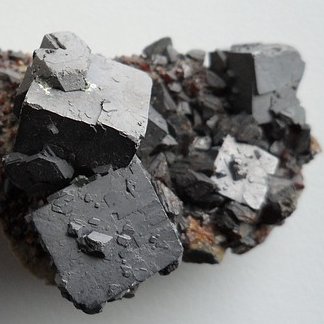
Paul takes the excuse to geek out a bit about how minerals evolve as well. The fairly averaged, semi-homogenous solar nebula that gave birth to the Sun and planets condensed into particles, a few of which collected into the rocky planets like Earth and Mars. From their original fairly undifferentiated state, these planets evolved by segregating out a core full of reduced metallic iron, while the surface was irradiated by the Sun and oxidized. On Earth the process led to even more evolution of minerals as its watery surface gave birth to life, and that life eventually started pumping this ludicrously caustic gas we call "oxygen" into the atmosphere. Of the many thousands of minerals known to science, a very large proportion of them have come into existence only since that time as minerals have "evolved" to meet the "demands" of Earth's unique atmospheric chemistry.
Getting back to religion...if evolution is a concept contained within Christianity, why are other instances of it now claimed to be alternatives to it? One major influence is the trend of the latter half of the second millennium to rebel against the hypocritcal leadership of theoretically Christian kings and prelates who luxuriated in wealth and power. Once there were Protestant churches, these were eventually rebelled against as well, and now the secular institutions and culture are engaged in attacking themselves. The habit of criticism has certainly allowed us to make astounding advances in science--20th century physics could not have emerged without it. Yet the cry "totally revolutionary new way of..." is now a hackneyed piece of salesmanship all across our culture.
Next time we plan to start discussing some of the concepts of philosophy of science, including the role of criticism and falsification. Paul wants to ask whether there's really such a hard line between religion and science as is commonly supposed, both by religion's enemies and its adherents...
Tuesday May 01, 2018
Tuesday May 01, 2018
Bill asks about whether evolution and the randomness it seems to imply are problematic for faith. Paul discusses the difference between evolution in biology (with a succession of species) and physics (where new laws layer on top of old laws without destroying them). We talk about the mindsets of physicists and biologists, and tangle more with that problematic phrase "shades of gray." Bill confronts Paul with Einstein's comment that "God does not play dice," and Paul responds with commentary mostly from Harvey Brown and Steven Barr about the alternative interpretations of quantum theory: hidden variables and determinism, or the Copenhagen sense that the probabilistic interpretation of quantum events is physically, ontologically, metaphysically real, and the room in the Copenhagen interpretation for interactions between the spiritual (souls, God) and the physical (body, miracles).

Monday Apr 23, 2018
Monday Apr 23, 2018
Paul elaborates on how the hylomorphic principle, if anything, fits quantum physics better than it fit the world the medievals knew. Bill asks whether the worldview of people of faith is too rigid, while that of the secular masses is too loose. Paul wonders what "shades of gray" really means, and points out that even though the materialist worldview has become harder and more dogmatic, 20th century physics really exploded its scientific foundation. This epsiode brought to you by Arthur Compton's Freedom of Man and Stephen Barr's Modern Physics and Ancient Faith.
Monday Apr 16, 2018
Monday Apr 16, 2018
Bill and Paul talk about whether the old convention of hylomorphism at least initially seems to describe the world of quantum physics, the medieval dispute over plurality of forms, and the degree to which science and philosophy became delinked in the late second millennium.