Taking science AND faith seriously.
Episodes
Dec 3, 2018
Dec 3, 2018
24 min
The times below are continuations from the last episode. My opening is about 1:30, and then we start with galaxy motions at "26:00".
26:00 Galaxy motions
27:00 Galaxy rotation curves: do not match Keplerian orbits
28:00 Galaxies spin more like records (laggy soft records); mass distribution is nothing like the Solar System
29:00 Hurricanes as a better analogy for galaxies
30:00 Stars in a galaxy move in local organization
32:00 Nebulas
34:00 The opposite extreme: rigid body rotation
35:00 Gravitational attraction between stars creating coherence
36:00 Curiosity that gravity and electrical forces are both inverse square laws
37:00 Poisson's equation
38:00 Summing densities in Poisson's inhomogeneous term is physically meaningless; intensive quantities can't be summed that way
40:00 Gauss' theorem: flux through a surface and quantity within a volume
41:00 Summing is for extensive variables
42:00 Pressure an ambiguous variable
43:00 Future work
44:00 Thermal expansivity: Giauque
45:00 Problems with the glass transition measurements done in the past: need to completely drive out water from the experimental charges
48:00 Wrapup
Nov 26, 2018
Nov 26, 2018
28 min
TSSM goes heavy: hard-hitting journalism from one of science's great controversialists, Anne Hofmeister. Intrigued? Disagree? Write me an email (giesting@alumni.nd.edu) or look her up at Washington University in St. Louis' EPS department website.
The times below are keyed to the start of the interview and ignore my opening (just over 2 min).
0:00 Introduction
1:00 Anne's background (sorry, this part Anne was talking so quietly that I can't seem to fix it with Audacity, but bear with us; we moved the microphone and figured some things out and it gets better)
2:00 Spectroscopy and heat transfer
3:00 Thermal conductivity experiments and their pitfalls
5:00 Criticism of the history of thermodynamics and heat transfer; identification of light and heat
6:00 Problems with equilibrium and elastic collisions in theories of thermodynamics
8:00 Criticism of phonon theory
10:00 Electron and vibrational transfer of heat decoupled; metals and heat transfer
13:00 Garnet
14:00 Earth's interior: convection, the Rayleigh number
15:00 Viscosity
16:00 The Earth's mantle: nearly all solid
17:00 Plate tectonics without mantle convection
18:00 An even more radical idea: heat is being trapped inside the solid Earth
19:00 [there was a distortion I had to cut]
20:00 Implications: heat generation is in the crust (this part is widely known!)
21:00 Implications: the core is melting, not solidifying?
22:00 The geodynamo and magnetic field
23:00 The core: buffered at the temperature of melting high pressure iron
24:00 Magnetic modes diagram for the planets: spin and magnetic field
Nov 19, 2018
Nov 19, 2018
20 min
~0:00 Question: advice for students
1:00 Don't be afraid to be a religious scientist
2:00 Particular issues
3:00 Keep awake to the wonder of the world
4:00 Bill: ignorance of the common man about both science and religion
5:00 Modern Physics and Ancient Faith
6:00 Christopher Baglow: science and faith textbook
7:00 Church beginning (at long last?) to address the need to catechize & educate about this
Phone ringing can't be excised without gutting Bill's question!
8:00 Media's portrayal of religion as boring and science as exciting
9:00 Science explores the world as it is, but there must be issues beyond: "why" issues
10:00 Intellectual freedom necessary for science to make any sense
11:00 No reason for Catholics to fear science uncovering fatal problems for faith
12:00 20th century overturn of 19th century mechanistic, unfree universe
13:00 Advent of the big bang theory, verification through microwave radiation
14:00 Bill: "free will on steroids" in uneasy coexistence with materialism
15:00 Barr: inherent conflict there
16:00 Pernicious recurring feature of intellectual history: excuses not to be free
17:00 Bill: does faith make one a better scientist?
18:00 Wonder: "ears to hear and eyes to see"
19:00 Summation: join Society of Catholic Scientists!
20:00 Sign off
Nov 12, 2018
Nov 12, 2018
24 min
Minute Comment
0:00 Paul introduces
1:00 Bill: Lemaitre announcement
2:00 Lemaitre: faith & science not opposed
3:00 Barr: Lemaitre announcement
4:00 Ignorance of Lemaitre
5:00 Ignorance of the Christian, Catholic origin of science & famous Catholic scientists
6:00 Barr: late 19th century critical period for the forging of the myth of Church as anti-science
7:00 Science only professionalized in the late 19th century, looking for influence
8:00 More famous Catholic scientists
9:00 Mission of the Society of Catholic Scientists; religious people looking askance at scientists, 10:00 Scientists timid about showing their faith in the presence of a few loud atheists
11:00 Catholic scientists joining SCS & finding others like themselves
12:00 Witness to the world
13:00 Conferences, past and future: next June at Notre Dame
14:00 2017: origin of universe, life; 2018: mind and matter
15:00 2019 conference: what is it (and has it been) to be human; speakers from outside the faith
16:00 Past non-Catholic conference speakers
17:00 Peter Koellner's talk at 2018 conference
18:00 Koellner and Godel's theorem
19:00 Neaderthals, language, reason
20:00 Godel's beliefs about mind and mathematical truths
21:00 Mathematical truth and religious truth
22:00 Depth & sophistication of the law that governs the universe
Nov 5, 2018
Nov 5, 2018
39 min
Intro: Nobel Prize announcements
Donna Strickland
Nadia Murad
Segue: Lemaitre press release
Transition: the early 20th century golden age from Chesterton to Fulton Sheen
Theme: All Saints Day
Augustine
Isidore
Albert the Great
Roger Bacon
Nicolaus Steno
Gregor Mendel
Georges Lemaitre
Please leave us feedback here by hitting the "Email Paul" link or using the "Facebook" link and commenting or messaging us there.
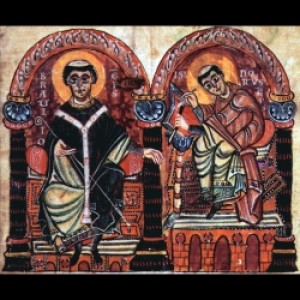
Image: Braulio of Saragossa and Isidore of Seville, writing his Origins (Etymologies)
Oct 29, 2018
Oct 29, 2018
1 min
We hope you've enjoyed the podcast so far, and in particular our last two episodes with Guy Consolmagno.
TSSM has been running for over six months now, and we would love to get your feedback on how to make it better:
- What topics or approaches have you liked and want more of?
- Whom should we seek out for interviews? We definitely are cooking up our own lists, but you can influence us!
- What should we do less of?
- What about the audio works or bothers you?
- Volume (too low, too high, not consistent enough?)
- Quality (noise, voices muffled, other problems)
Feel free to comment at our Facebook page (look at the Links section to the right) or send Paul an email (there is also a link for that). We are really looking forward to hearing from you.
Oct 29, 2018
Oct 29, 2018
29 min
Paul moves from popular books to Br. Guy's 1990s planetary science textbook, Worlds Apart which Paul switched to in 2015, despite its age, precisely because of Br. Guy's explicit acknowledgment that "students want to learn about THE PLANETS." The chapters of the book therefore start with a saga of some planet, and then focus in on some process that is well exemplified on that planet. Other textbooks try to focus on processes and lose ME, let alone my students, most of whom were headed toward high school teaching.
Br. Guy goes on from the subject of his books to talk a little about John Scalzi's take on the common advice to authors to "kill your darlings"..."the failure mode of clever is idiot." (I am not unfamiliar with John Scalzi, who is certainly a master of the craft: see my review of Old Man's War on Goodreads.)
Bill references the science & religion initiative at the McGrath Institute at Notre Dame, to which Br. Guy has contributed. The Institute tries to form high school teachers with a sense of the complementary, rather than adversary, nature of science and faith. Br. Guy goes on to talk about how hard a high school teacher's job is, and the need for enthusiasm in presentation. If you are listening to two enthusiastic people talk shop about almost any topic, however little you yourself know about it, you get drawn in. That's the goal, except most high school teachers have to do it by themselves.
A teacher that can maintain enthusiasm and also model comfort with not knowing the answer and intellectual humility..."I don't know; let's go find the answer"...is a great gift to insecure, "self-conscious but not self-aware" teenagers.
Paul probes Br. Guy about the modern attitude of trying to discard as much of the past as possible. Br. Guy comments how living in Italy gives you perspective on how the attitude has shifted from the medieval attitude (discussed in great depth by CS Lewis in The Discarded Image) of reverence for the past, whose achievements we could never match, to the modern one. Rome gives you the perspective that while science and engineering may have advanced, art and architecture have not. Humanity can only progress so far...we can't get away from original sin. We do things we know are wrong, destructive, etc. That's why Twelve Step programs exist. A great 20th century tragedy, as has been noted many times, is the failure of great schemes (like communism) for revising society in some theoretically perfect new form.
A chance reference to Shakespeare, and then to Star Trek VI (of course), leads us off into a discussion of language and the way it shapes our lives, from the fun people have had since Tolkien inventing whole new languages, to the difference in what Sarah cooks for Abraham's visitors in English (yuck) versus Italian. Br. Guy makes the provocative statement that one has to learn more new words in freshman biology than in freshman French. When you learn philosophy, you learn new words, and with those words (if you're really learning them) you learn new ways of thinking.
As a final note, that's why you need others to truly learn and work in a subject...or in a faith. The Ethiopian that Phillip baptized in the Acts of the Apostles had a hard row to hoe.
https://vofoundation.org/faith-and-science
Books mentioned in the interview:
Wind, Sand, and Stars by Antoine de Saint-Exupery
Unapologetic by Francis Spufford
The Rock by T.S. Eliot
Image courtesy Robert Macke (wikimedia Commons)
Oct 22, 2018
Oct 22, 2018
28 min
Br. Guy starts with a brief bio of himself as the meteorite curator and now director of the Vatican Observatory. If you aren't familiar with his life and career, I cannot suggest strongly enough to go find a copy of Brother Astronomer. Paul takes the opportunity to geek out a bit about the VO's collection of Martian meteorites, which includes pieces of varying size of the three flagship members of the three great classes of Martian meteorites: Chassigny, Shergotty, and Nakhla. We discuss the romance and suspense of finding meteorites in the dry deserts.
Paul then poses the question of the recently discovered Galileo letter. Br. Guy defuses a bit of the noise surrounding this letter, likening the situation to scientists down to this very day putting out provocative theses and then pulling them back under criticism from their peers.
(My dog Riley starts barking at UPS personnel sometime between 13:00 and 13:30. This was an eventful session.)
Galileo in his time was rather like Carl Sagan in his time: a popularizer and a controversialist. Br. Guy, who met Carl Sagan a few times, recognizes the value that both of these controversial figures brought to the field. He goes on to discuss the travails that Sagan faced in his own life, dealing with fame and the risks he ran to get his message out (the massive debt he incurred in making Cosmos) and notes his own fraught relationship with his own faith.
Carl Sagan was a serious scientist, in the 1960s one of the first to grapple with the unexpectedly, incredibly hot temperatures the first Venus probes reported and to link it with the very thick carbon dioxide atmosphere Venus has.
Br. Guy talks a little about his experience "coming out" as a religious believer, and the opposition he _didn't_ receive in publicizing his decision to become a Jesuit. He moves on to discuss the romance of science, why we're attracted to it, and why it's important to steer a middle path (that Aristotelian mean again) in both science and faith between "I already know everything worth knowing" and "God / the universe is so big I can never understand it." Of course you won't learn it all, but of course you'll be able to learn and love something. He likens it to a good friendship or romantic relationship, in which you rejoice in both the known and the unknown.
Paul probes Br. Guy on whether Sagan influenced him in his own popular books. Br. Guy professes that not only did Carl Sagan influence his confidence in being able to discuss the wonders of planetary science and astronomy with a popular audience, as well as his colloquial tone, but even his wardrobe served as a good precursor (compare Carl at https://www.imdb.com/name/nm0755981/ with Guy at https://www.radiokerry.ie/portraits-of-gc36-delegates/ and for good measure another great Italian scientist who wore the collar well https://www.torinoscienza.it/personaggi/giuseppe-mercalli).
Image courtesy Robert Macke (wikimedia Commons)

Oct 15, 2018
Oct 15, 2018
29 min
For a change of pace, we discuss emotions and aesthetics and the sense of awe at the scale of the universe and the planet that we inhabit. Paul discusses the "billion year contacts" at his old stomping grounds in the St Francois Mountains of southeast Missouri and the lost world of the earliest visible life in the Burgess Shale. Paul and Bill close with a reflection on how the awe that we feel at comtemplating the enormous scale of space and time of the created world ought to make us better appreciate the audacity of the Christian claim that the Being who set all of this in motion...emptied Itself and became man.

Oct 8, 2018
Oct 8, 2018
30 min
In this episode we continue into the next logical topic, absolute dating, which is done via measurement of radioactive parent and daughter isotopes. Thus we move from the 19th century and classical physics into yet another way in which 20th century physics has revolutionized science.
Paul gives a rundown, with many apologies for the exact data of isotope numbers and half-life lengths he has managed to forget, of the theory of radioactive decay. Bill, our proxy for the man on the street, starts us off with a common notion of half-life. From there we cover some of the basics and most commonly used isotopic systems: uranium-lead, thorium-lead, a discussion of why carbon 14 is so seldom used in geology, potassium-argon, and a note that more systems are always being brought into use. We discuss the distinct types of rocks that are best used for radiometric dating and how the relative dating methods have to be used in an interwoven system with radiometric dating in order to assemble the whole system of geochronology that we use today.
We end the podcast with a discussion of how science is the very opposite of a conspiracy theory or a political campaign. The geologic dating systems need interlocking data, and they also benefit from it. In such a system, contradictions do spring up--one study doing biostratigraphy might conflict with another using zircons. What science does is not to sweep that under the rug...instead we throw resources and graduate students at it until we get a resolution to the conflict.
(Zircon photo credit Harald Schillhammer via mindat.org. Note the pink and brown coloration...brown zircon is commonly that color due to radiation damage from the uranium and thorium it contains.)